Cadgwith Cove: A Visitor's Guide to the Lizard's Working Fishing Village

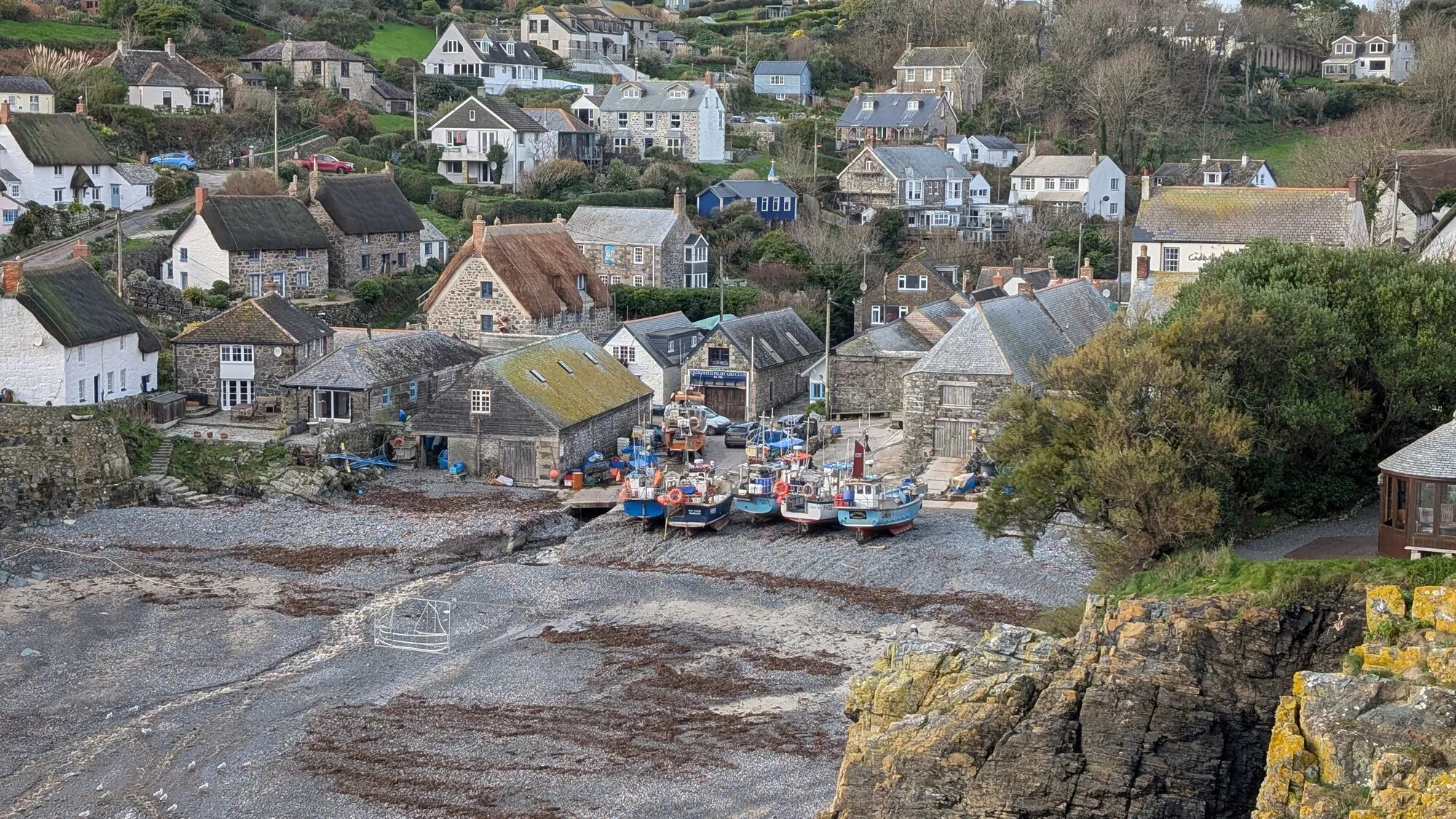
Cadgwith is one of Cornwall's quietest classics: a small working fishing village on the eastern coast of the Lizard Peninsula, with thatched cottages clustered at the back of a pebble cove, a handful of day boats hauled up the slipway, and a famous village pub at the heart of it. It is genuinely working, genuinely small, and genuinely worth the drive. Half a day in Cadgwith, with a coast walk and a pub lunch, is one of the better quiet day-out plans on the Lizard.
This is a guide to visiting: how to find it, what to do, the famous Devil's Frying Pan, and how to make a proper half-day of a Cadgwith stop.
Where it is
Cadgwith sits on the eastern coast of the Lizard Peninsula, around an hour south of Falmouth via the A39 and A394 to Helston, then the A3083 south through the Lizard. The village is reached down narrow lanes from the main road, signposted from Ruan Minor.
The clifftop car park sits about five minutes' walk above the village on the lane in. Pay-and-display in summer; it fills early on busy days. The village itself has no parking. From the car park it is a gentle downhill walk into the village; the return is the only properly uphill bit of the visit.
Cadgwith village
The village clusters around a small pebble cove with a working slipway. Thatched-roofed fisherman's cottages line the lanes, many of them whitewashed, several with names like "The Old Pilchard House" or "The Salt Cellar" reflecting the village's pilchard-fishing past. Cadgwith was a major pilchard-fishing port in the 19th century, with the catch processed in the village's salt cellars before being exported to the Mediterranean.
The fishing today is small-scale but genuinely working: a handful of day boats based on the cove, crab and lobster the main catches, the boats hauled up the beach by tractor at high tide. Crab pots are stacked on the slipway in the working months. There is a small fishing-cooperative shop selling fresh-caught crab and lobster from the morning's landing.
The Cadgwith Cove Inn is the village pub: a small traditional Cornish pub on the lane just up from the slipway, low-ceilinged, fresh-fish menu, real ales, and a famous Friday-night singalong of Cornish songs and shanties that runs through summer. The Inn is the social heart of the village; book ahead for food in season.
A small art gallery and cafe complete the village amenities. There are no shops or supermarkets; this is a working fishing cove, not a tourist village.
The Devil's Frying Pan
The dramatic walking destination from Cadgwith is the Devil's Frying Pan, around 15 minutes south along the South West Coast Path. This is a collapsed sea cave: centuries ago, the roof of an enormous sea cave fell in, leaving a circular crater (about 60 metres deep and 60 metres wide) connected to the open Atlantic by a narrow rock arch.
Atlantic waves push through the arch into the crater, often with spectacular force. In a big winter swell, the spray and noise from the Devil's Frying Pan are extraordinary, and the crater steams and roils in a way that earned it its name. Even on calmer days the geology is striking, and the cliff walk to reach it gives some of the best wide-Atlantic views on the eastern Lizard.
For more on the wider Lizard cliff walks, see our hiking the Lizard Peninsula guide.
Walks from Cadgwith
Cadgwith sits directly on the South West Coast Path, with strong walking options in both directions:
- South to the Devil's Frying Pan (15 minutes) and on towards Lizard Point (around two hours total). One of the more dramatic SWCP stretches on the Lizard.
- North towards Coverack (a longer half-day walk along the eastern Lizard cliffs and quieter coves). Coverack is around 5 miles north and is a possible end-point for a full one-way walk if you can arrange a pickup or a bus back.
- Inland circular walks through the small fields and lanes behind the village, returning via the cliff path. About an hour for a short circular.
Visiting practicalities
Parking: clifftop pay-and-display, fills quickly in summer.
Toilets: at the small toilet block in the village.
Eating: the Cadgwith Cove Inn is the main option, with the fresh-fish menu and proper pub atmosphere. The small village cafe opens for coffee and lighter lunches in season. For a properly fancier meal, drive 15 minutes to Lizard village for the Top House Inn or back inland to Helston for more options.
Buying fresh seafood: the fishing-cooperative shop sells crab and lobster from the morning's catch, when they are running. Hours are weather-and-catch-dependent; ask in the village.
Accessibility: the village is on a slope and the cliff paths are steep in places. The pub and the village itself are walkable for most visitors but not buggy- or wheelchair-friendly down the steepest lanes.
When to visit
Summer (June to September) is busy but lovely: fishing boats out, pub buzzing, Friday-night singalongs running, the cove at its most colourful. Arrive early on weekends.
Late autumn and winter are atmospheric: the Devil's Frying Pan at its most dramatic on big swells, the village pubs warm with wood-burners, the cliff walks empty, the working fishing slowed but still running on calm days. Cornwall's mild winter climate means Cadgwith is rarely snowed in.
The Friday-night singalong at the Cove Inn is a Cornwall bucket-list item. It runs through summer; check the pub's social media or call ahead.
Beyond Cadgwith
For the wider Lizard, Cadgwith pairs naturally with:
- Kynance Cove 20 minutes west on the other side of the Lizard, the picture-postcard turquoise beach.
- Lizard Point 15 minutes south-west, the southernmost tip of mainland Britain.
- Coverack 15 minutes north, a similar working-village atmosphere with a wider beach.
- Dollar Cove and Church Cove 25 minutes north at Gunwalloe, the twin NT beaches with the famous clifftop church.
For day-trip itineraries from a Falmouth base:
- The Lizard one-day road trip covers Cadgwith alongside the rest of the Lizard.
- Hiking the Lizard Peninsula for the full cliff-walking version.
- A long weekend in Cornwall for couples fits Cadgwith into a wider Cornish itinerary.
- The best places to stay in Cornwall for the wider regional context.
- The National Trust guide to Cornwall for the wider NT context (the Cadgwith car park is council-run, but the cliffs north and south are NT-managed).
Tags
Stay in touch
Occasional Cornwall updates from Rich at Trewena. Around four times a year, never more.
Planning a trip to Cornwall?
Three one-bedroom cottages on a smallholding on the edge of Falmouth. A genuine Cornish base for couples and singles.