Dollar Cove and Church Cove at Gunwalloe: A Visitor's Guide to the Lizard's Twin Beaches

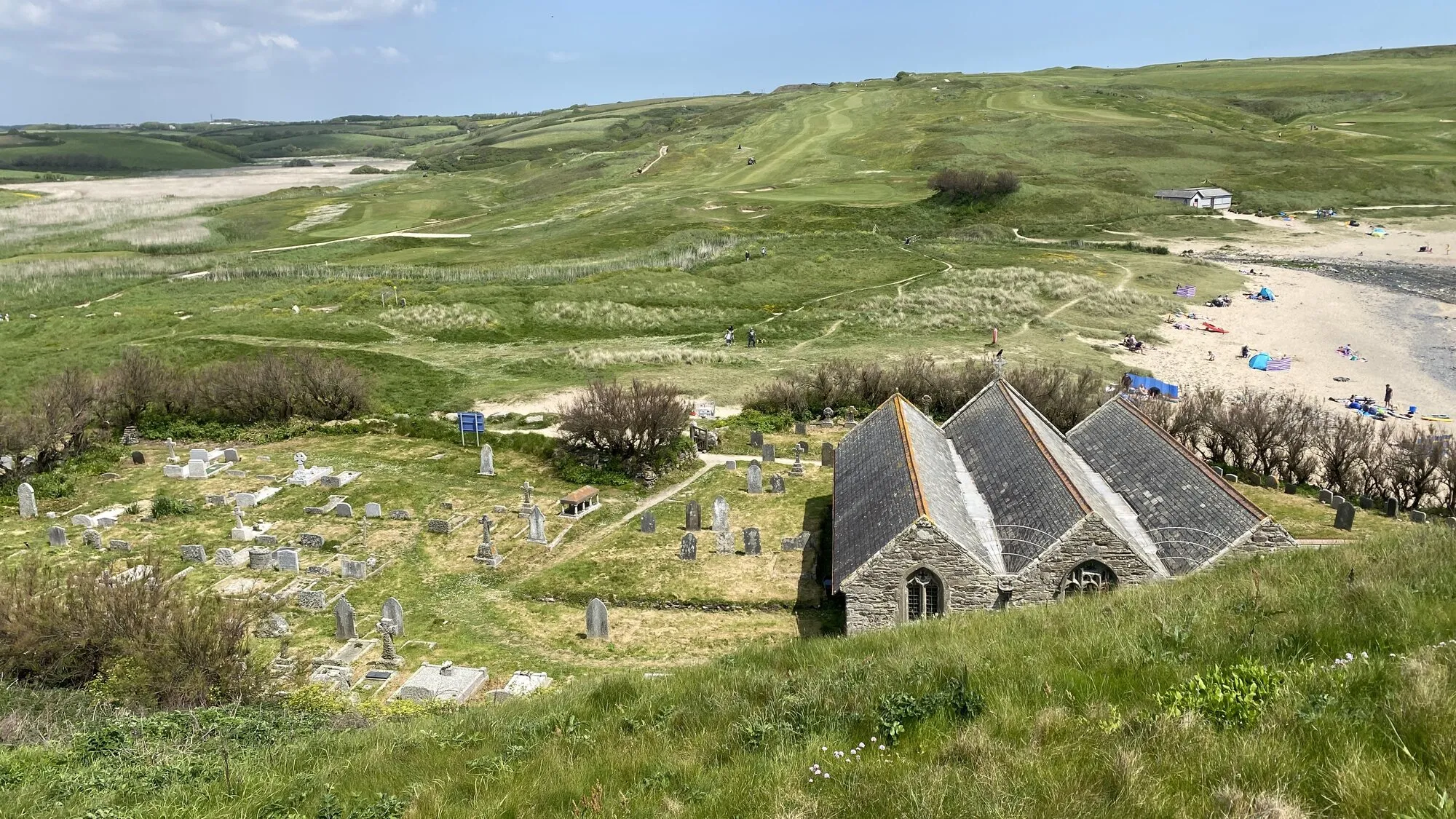
Dollar Cove and Church Cove at Gunwalloe are two of the Lizard Peninsula's quieter classics: a pair of National Trust beaches sharing a single car park, separated by a headland, each with its own distinct character. One sandy and bucket-and-spade for the family beach day, the other pebbly and rocky and dog-friendly all year. Plus a 14th-century church built directly into the back of the bigger beach, with a separate detached tower and centuries of Atlantic weather behind it. They are absolutely fabulous beaches in the proper sense of the word, and a brilliant pair for a half-day visit.
This is a guide to visiting both: what each beach offers, the church and its history, the famous Dollar Cove legend, and how to fit them into a wider Lizard or Falmouth itinerary.
Where they are
Gunwalloe sits on the western coast of the Lizard Peninsula, around 30 minutes south of Falmouth and 10 minutes south of Helston. The Gunwalloe National Trust car park sits at the head of a small coastal valley, between the two coves. From here:
- Church Cove is a five-minute walk south, across a short path and down through the dunes to the back of the church and beach.
- Dollar Cove is a closer to the entrace of the car park, opposite the public conveniences taking you to a smaller, rockier beach.
The car park is paid for non-members, free for National Trust members. Both beaches are on the South West Coast Path, and the headland between them gives the kind of wide-Atlantic views that the western Lizard does so well.
Church Cove
The bigger of the two beaches, and the one most visitors photograph: a wide sweep of golden sand backed by dunes, the small valley of the Looe Bar marshland behind, and the rolling green of Mullion Golf Club rising up the cliff to the south.
The headline feature is the Church of St Winwaloe, a 14th-century parish church built directly into the dunes at the back of the beach. The church is one of the most unusual in England: rather than a tower attached to the body of the church, the granite bell tower stands separately, built into a rock outcrop above the church itself. The tower predates the main church and was likely incorporated into the structure when the church was rebuilt in the 14th and 15th centuries. The full name is the Church of the Storms (Eglos an Hagas), a name that earns itself on a winter Atlantic-blow day.
The church is an active parish church with regular services. The graveyard around it includes weathered medieval Celtic crosses and stones marking the burials of sailors lost on this coast over centuries. The whole assembly, sand-and-dune-and-Norman-stone, is one of the more atmospheric coastal churches in Britain.
For visitors, Church Cove is the family beach: sandy bottom, gentle gradient, easy from the car park, the church-and-dune backdrop, classic bucket-and-spade. It does have summer dog restrictions (typically May to September, with dogs welcome before 8am and after 6pm).
Dollar Cove
The smaller beach a few minutes' walk north of the car park. Pebbly and rocky rather than sandy, with darker grey sand, dramatic exposed cliffs, and rockpools at low tide. Quieter than Church Cove because of the harder underfoot and the fewer beach-day amenities. It is dog-friendly year-round, which makes it a popular pick with the local dog-walking community.
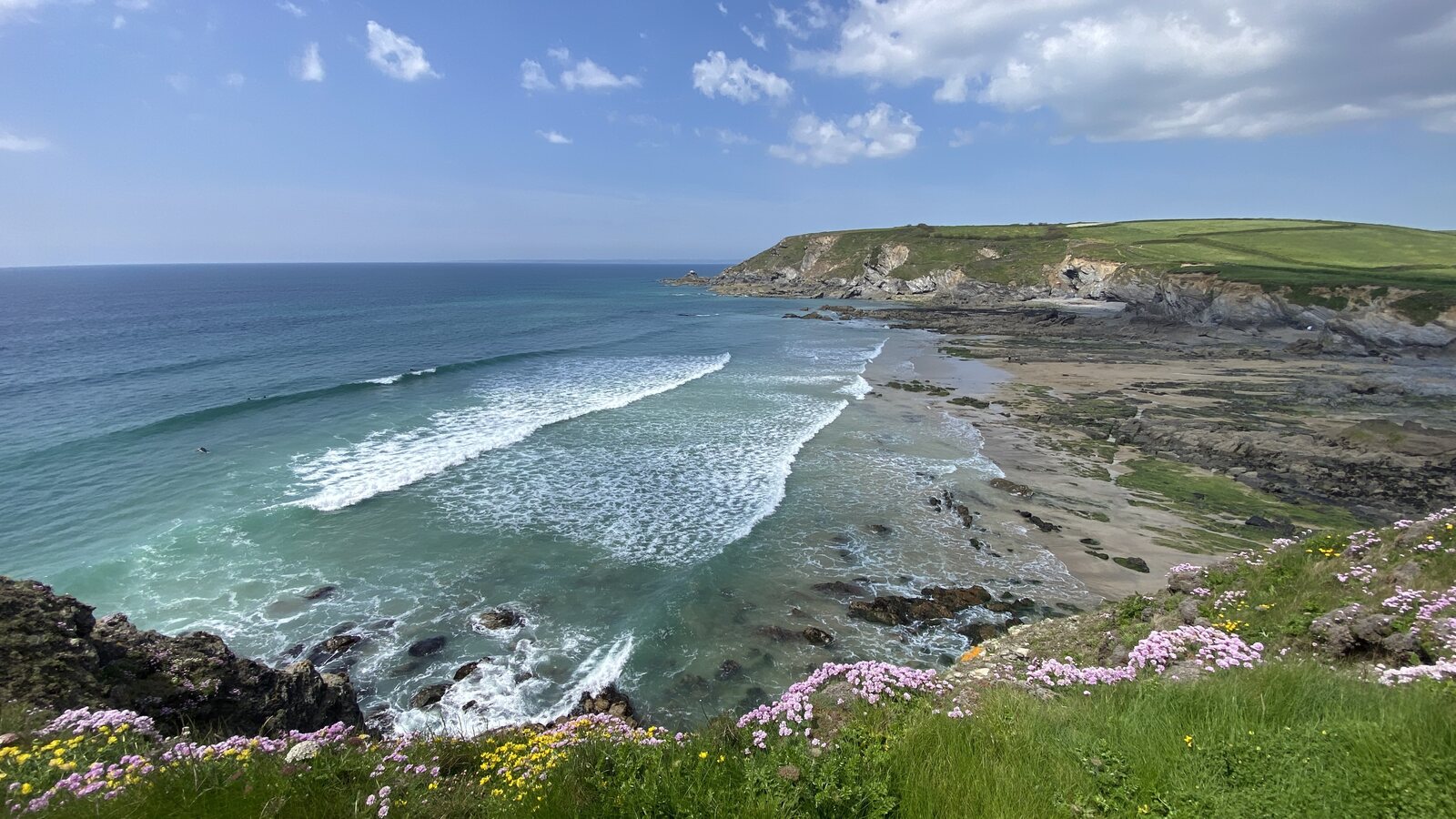
The cove takes its name from a Spanish galleon wrecked on the rocks here in the early modern period (sources variously place it in the 16th or 18th century). The wreck is said to have been carrying a fortune in Spanish silver dollars (the famous "pieces of eight"), and for centuries afterwards, silver coins washed up on the beach after winter storms. The legend is well-attested in local records, and coins are still occasionally found by beachcombers today, especially after big swells. Whether you find one or not, walking the beach knowing the story is its own kind of pleasure.
Practically, Dollar Cove is more for paddling, rockpooling and clifftop walking than for proper swimming. Rocks under the surface make it safer to paddle than to swim, and the water can be deceptively choppy in onshore winds. For a proper swim, head south to Church Cove or further south to Polurrian or Poldhu Cove.
Walking between the two
The South West Coast Path runs along the path between Dollar and Church coves. The full short circular walk from the car park, to Dollar Cove, around the edge of the headland that seperates them and down to Church Cove, and then back to the car park via the church and dunes, takes around 20-30 minutes at an unhurried pace. The headland between the coves has some fabulous vistas of the western Lizard, with views in both directions along the coast.
For more on the wider Lizard cliff walks, see our hiking the Lizard Peninsula and Lizard one-day road trip guides.
Visiting practicalities
- Parking: the Gunwalloe NT car park serves both beaches. Paid for non-members, free for NT members. Fills fast in summer; arrive before 11am or come outside peak hours.
- Toilets: at the car park (open all year).
- Cafe: there is a small seasonal cafe at the car park selling coffee, ice creams, sandwiches and Cornish-leaning cake. For a proper lunch, the Halzephron Inn at Gunwalloe village (10 minutes back up the lane) is the local pub and one of the better pub-food picks on the Lizard.
- Lifeguards: Church Cove is RNLI lifeguarded in the summer. Dollar Cove is not. The nearest other summer cover is at Poldhu Cove or Polurrian Cove a few miles south. See our seaside safety guide before any swim.
- Best time to visit: May to September for warmth and colour; January through March for atmospheric Atlantic-storm visits to the church and a near-empty beach.
Beyond Gunwalloe
For the wider Lizard, Dollar and Church Cove pair naturally with:
- Mullion Cove and Polurrian Cove five minutes south, with the famous Mullion harbour and the long sandy Polurrian.
- Kynance Cove 15 minutes south, the picture-postcard turquoise beach of the Lizard.
- Lizard Point itself, the southernmost tip of mainland Britain.
- Helston 10 minutes north for lunch and the Saturday-morning Furry Dance if you're visiting in May.
For day-trip itineraries from a Falmouth base:
- The Lizard one-day road trip takes in Gunwalloe, Mullion, Kynance and the Lizard Point in a single day.
- Hiking the Lizard Peninsula covers the full cliff-walking version.
- The best beaches near Falmouth puts Gunwalloe in context alongside the closer Falmouth Bay beaches.
- The National Trust guide to Cornwall for the wider NT car park network across the Lizard and beyond.
- A long weekend in Cornwall for couples for an itinerary fitting Gunwalloe in alongside the rest of the Lizard.
Tags
Stay in touch
Occasional Cornwall updates from Rich at Trewena. Around four times a year, never more.
Planning a trip to Cornwall?
Three one-bedroom cottages on a smallholding on the edge of Falmouth. A genuine Cornish base for couples and singles.