Unusual and Funny Cornish Place Names (and the Stories Behind Them)

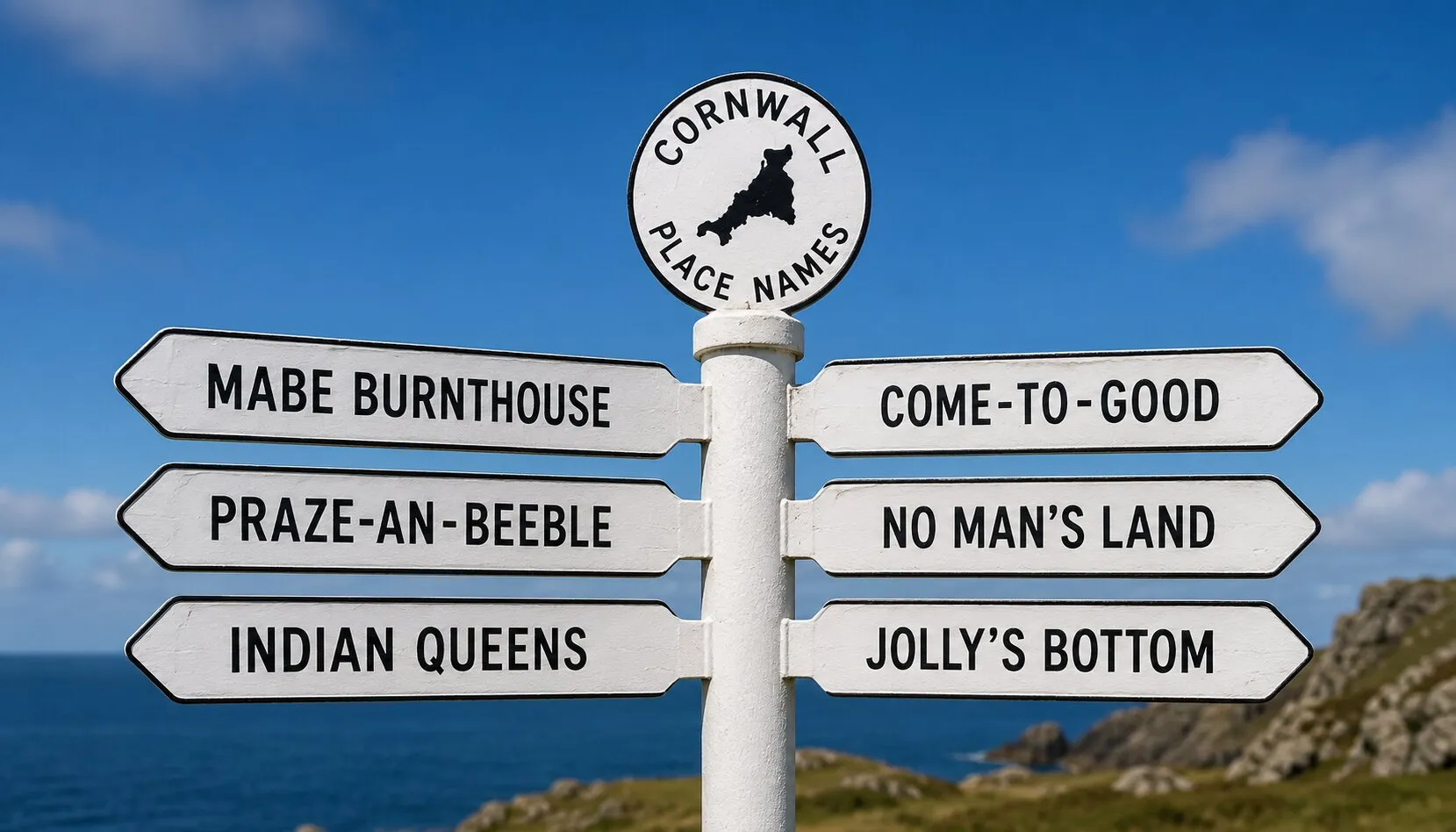
Spend any time on the Cornish lanes and you will do a double-take at the road signs. Cornwall's place names are a language of their own, sometimes literally, and they run from the ancient and poetic to the frankly ridiculous. We happen to live in a village called Mabe Burnthouse, so we come by this affection honestly. Here is a tour of the county's oddest, funniest and most intriguing names, and what is actually known about where they came from.
By Tre, Pol and Pen
There is an old rhyme: "By Tre, Pol and Pen shall ye know all Cornishmen." It points at the Cornish language, a Celtic tongue related to Welsh and Breton, spoken widely here until the 18th century and gently revived today. A great many Cornish place names are simply Cornish words describing the land, and a handful of elements do most of the work:
- Tre means a farm, homestead or settlement (Tregony, Trelissick, and our own Trewena)
- Pol means a pool or pond (Polperro, Polzeath, Polruan)
- Pen means a head, end or hill (Penzance, roughly "holy headland", and Penryn, our nearest town, "promontory")
- Lan means a church enclosure (Lanhydrock, Landewednack)
- Ros means a heath or promontory (as in the Roseland)
- Car means a fort or stronghold
Once you know them, half the map decodes itself. It also explains why so many names cluster: they are descriptions, not inventions.
The names that make you giggle
Then there are the ones that need no translation to raise a smile.
- Brown Willy, the highest point in Cornwall on Bodmin Moor, is the county's most enduring tea-towel joke. The name is a worn-down version of the Cornish Bronn Wennili, usually translated "hill of the swallows". Poetic origins, unfortunate English spelling.
- Praze-an-Beeble, near Camborne, comes from the Cornish for something like "the meadow of the pipe or conduit". It sounds made up. It is not.
- Jolly's Bottom and Skinner's Bottom, over towards Chacewater and Porthtowan, use "bottom" in its old sense of a valley floor. The names still get a grin.
- No Man's Land near Looe, Cocks near Perranporth, and Come-to-Good near Feock, the last home to a beautiful thatched Quaker meeting house from 1710. Come-to-Good's name is sometimes said to be a worn-down Cornish phrase and sometimes taken at cheerful English face value. Nobody is quite sure, which is half the charm.
Cornwall's little world tour
Scattered across the county you will find Egypt, Jericho, Salem, Goshen, Bethel and Paradise, alongside Indian Queens, Barcelona, Brighton and Sheffield. Two things explain most of them.
The first is Cornwall's deep Methodist and Nonconformist roots. Through the 18th and 19th centuries, hamlets often grew up around a chapel, and chapels frequently took biblical names, so a scatter of Jerichos and Salems is really a map of Cornish chapel culture rather than any link to the Holy Land.
The second is the old coaching inns. A surprising number of odd names trace back to a long-vanished pub. Indian Queens, near Fraddon, is named for an inn called the Indian Queen. Who she was, Pocahontas or someone else entirely, is exactly the sort of thing a Cornish local will happily debate over a pint.
More little jokes on the map
Cornwall has a real gift for a wry name. There is Ready Money Cove at Fowey, Cripplesease near St Ives, Cost-is-lost near Camborne, Hard-to-come-by near St Agnes, Mount Misery, Paradise near Week St Mary, and London Apprentice near St Austell. Whether they came from a landlord's joke, a farmer's grumble or a chapel's hope, they give the Ordnance Survey map a personality you do not find in many counties.
Our own odd name: Mabe Burnthouse
We are biased, but our village holds its own. Mabe is the parish, an old name tied to its medieval church; Burnthouse is the hamlet, and its plain English name is traditionally said to come from exactly what it sounds like, a house that once burned down.
This was granite country. By the 1860s around half the men of the parish worked as stonemasons, cutting blocks from the local quarries, and Cornish granite from these parts ended up all over the place. Not bad for somewhere named after a fire. Our three cottages sit on the rural edge of it, which you can read more about in our guide to Mabe.
And how to actually say them
A short survival guide for reading them aloud without giving yourself away:
- Mousehole is "Mowzel"
- Fowey is "Foy"
- Marazion is "marra-ZY-on"
- Mylor is "MY-lor"
Get one wrong and a local will gently put you right. Get one right and you have passed a small, unspoken test. For the meanings of more Cornish terms you will meet on a visit, our visitor's glossary of Cornwall is the place to start.
Plan your visit
- Our guide to Mabe: the granite parish our cottages call home
- A visitor's glossary of Cornwall: the local terms worth knowing before you arrive
- The best base to explore Cornwall: why a central spot near Falmouth beats a single far-flung town
- Cottages for couples near Falmouth: how a Trewena stay works as your base
Come and get your tongue around a few of these in person. Our three cottages sit on the edge of Falmouth, in a village whose name we have grown rather fond of, or drop us a message about a stay.
Tags
Stay in touch
Occasional Cornwall updates from Rich at Trewena. Around four times a year, never more.
Planning a trip to Cornwall?
Three one-bedroom cottages on a smallholding on the edge of Falmouth. A genuine Cornish base for couples and singles.