The Minack Theatre: A Visitor's Guide to Cornwall's Open-Air Cliffside Stage

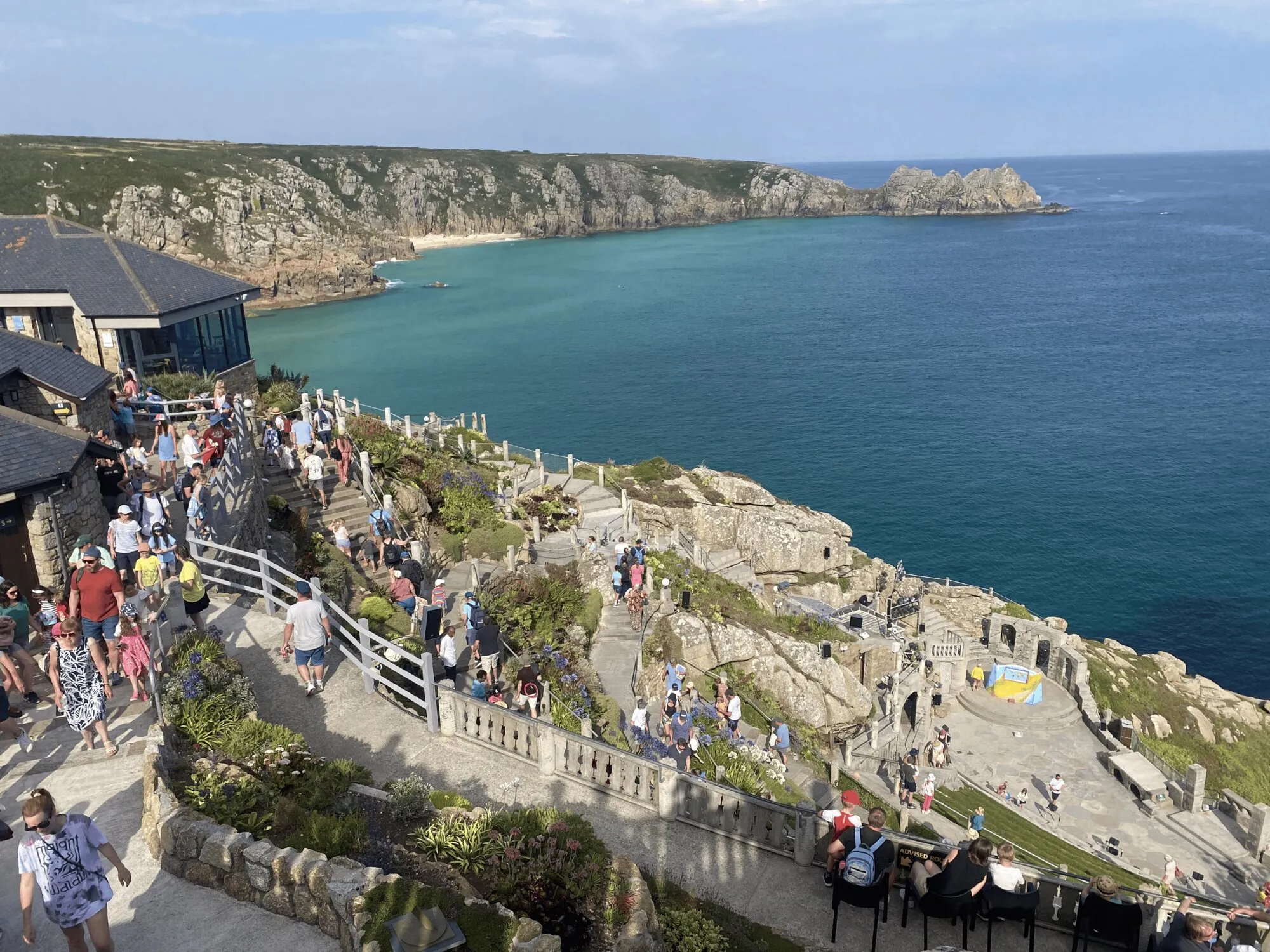
The Minack Theatre at Porthcurno is one of Cornwall's most extraordinary places: a 750-seat amphitheatre carved by hand into a granite cliff above the Atlantic, looking out over a turquoise bay, with Logan Rock as the visible backdrop. It is at once a working professional theatre with a 200-show summer season, a cultural institution shaped by one woman's seven decades of work, and a half-day visit you can do without seeing a single play.
This is a guide to visiting the Minack: how to plan a performance evening, what to see on a daytime tour, the founder's story, and how it fits into a wider Penwith day-trip.
Where it is
The Minack sits on the cliff above Porthcurno, on Cornwall's far western coast about three miles south-east of Land's End. From Falmouth it is around an hour and 15 minutes by car: A30 west, then signposted via Penzance and Newlyn to Porthcurno. The road in is narrow and winds through small Penwith villages; allow longer in summer.
There is a paid Minack Theatre car park on site (typically £6 for the day). For overflow on busy days the National Trust car park at Porthcurno itself adds another option a short walk down the hill.
What it is
The Minack is one of the few open-air professional theatres of its scale anywhere in the UK. The 750-seat amphitheatre is carved directly into the granite cliff, with stone-cut tiered seating descending towards a small flat stage built into the cliff edge. Behind the stage: the open Atlantic, Logan Rock on the eastern headland, and on a clear evening the silhouette of Pedn Vounder beach and the wider bay.
The summer performance season runs May to September, with around 200 performances by touring professional companies. The programme covers plays (often including Shakespeare), musicals, opera, dance, music and family-friendly children's shows. Tickets typically go on sale in early winter for the following summer, and the headline shows sell out fast.
In addition to performances, the Rowena Cade Exhibition in the visitor centre tells the story of the theatre's founder and its construction, and the clifftop gardens (with sub-tropical planting that thrives in the sheltered cliffside) are well worth a slow walk. The on-site cafe has views straight across the bay.
The founder: Rowena Cade
Most visitors arrive without knowing this, and it is the story that lifts the Minack from a beautiful place into something properly remarkable.
Rowena Cade moved to Cornwall in 1924 and bought the cliffside Minack headland for £100 with the intention of building a house. In the early 1930s, when a local amateur dramatic group needed an outdoor venue for The Tempest, Cade volunteered her cliff. She and her gardener Billy Rawlings spent the winter of 1931-32 hauling rocks and sand up the cliff face by hand and carving the first amphitheatre out of the granite.
The 1932 production of The Tempest was a success, and Cade kept building. For the next 50 years she carved, extended, repaired and rebuilt the theatre by hand, working into her eighties, often at night by torchlight. The names of plays staged there are inscribed into the seat-backs and stone walls, many of them carved by Cade herself with the points of screwdrivers and chisels.
She died in 1983, leaving the theatre to a charitable trust that runs it today. The Minack you visit is largely her work, and the founder's-house cottage is preserved as part of the visitor experience.
Visiting for a performance
If you can make a performance, it is one of the more memorable nights out in Cornwall.
Booking: the season is announced in autumn for the following year, and tickets go on sale in winter. Headline productions (Shakespeare, the bigger musicals) sell out months in advance. Mid-season weekday matinees are easier to get into. The full programme is at minack.com.
What to bring:
- Waterproof jacket and trousers, regardless of the forecast. Conditions change fast at the cliff edge.
- Warm layers for after sunset, even in midsummer. Atlantic evenings get cold.
- Cushions or a folded blanket for the stone seating (the cushion concession at the theatre charges, so bring your own).
- A flask if you want hot drinks; the cafe closes during performances.
- Sturdy footwear for the steps.
Performances run in almost all weather. The Minack has been open-air since the 1930s and the audience is expected to come prepared. Cancellations happen only in extreme conditions; refunds are offered.
Plan extra time to find parking, walk down to your seat, and take in the view before the show. Arriving an hour early is normal; many visitors picnic on the upper terraces watching the sun drop.
Visiting in the daytime
If you cannot make a performance, the daytime visit is genuinely worth doing on its own.
A standard daytime ticket lets you walk the amphitheatre, see the stage and the carved seat names, visit the Rowena Cade Exhibition, walk the gardens, and use the cafe. Allow 90 minutes to two hours. The view alone justifies the entry; the founder's story makes the whole site land harder.
Daytime opening typically runs 9.30am to 5pm in summer, with reduced hours in winter. Last admission is usually an hour before closing. Check minack.com before going, as performance days have shorter daytime opening (no daytime visits during scheduled rehearsals or evening setup).
Combining with Porthcurno and Pedn Vounder
The Minack sits at the western end of one of Cornwall's most spectacular coastlines, and the obvious day-trip move is to combine the theatre visit with the beaches below.
Porthcurno Beach is at the foot of the Minack cliff, reached by a steep path down from the theatre car park (or from the National Trust car park at Porthcurno village). White sand, turquoise water, sheltered swimming on calm days. RNLI lifeguarded in summer.
Pedn Vounder to the east is one of the most photographed beaches in Cornwall, often topping "best UK beaches" lists. The famous tidal sandbar that exposes at low tide gives the beach its turquoise-and-white-sand reputation. Access is via a steep cliff path from the SWCP and is not for the unprepared: the descent involves rock scrambling and is not suitable in wet conditions or for those with limited mobility. Worth it if you can manage it.
Logan Rock is the granite tor on the headland east of Porthcurno, a balanced rock that famously rocked when pushed. (A Royal Navy lieutenant pushed it off in 1824 to prove a point; he was forced to put it back at his own expense, and it has rocked less freely ever since.)
For the wider Penwith / wild west, see our Cornwall's ancient west walks and Sennen Cove and Land's End guides.
Beyond the Minack
For a full Penwith day-trip from a Falmouth base, the Minack pairs with:
- Porthcurno for the beach below and the Telegraph Museum in the village (a properly interesting visit on the early-undersea-cable-history theme).
- Land's End 15 minutes west, including the cliff walk from Sennen Cove (see our Sennen Cove and Land's End guide).
- Mousehole 20 minutes east, the photogenic small fishing village.
- Penzance 25 minutes east, with Mount's Bay and St Michael's Mount.
- St Ives 35 minutes north on the other coast, for the art scene and the Tate.
For day-trip itineraries:
- A long weekend in Cornwall for couples covers the western day-trip option in detail.
- The best places to stay in Cornwall for the wider regional context.
- Cornwall's ancient west walks: Penwith for the broader Penwith landscape.
- The best beaches near Falmouth for the south-coast comparison.
For tickets, the current season programme and the full visitor information, the official Minack site is minack.com.
Tags
Stay in touch
Occasional Cornwall updates from Rich at Trewena. Around four times a year, never more.
Planning a trip to Cornwall?
Three one-bedroom cottages on a smallholding on the edge of Falmouth. A genuine Cornish base for couples and singles.