Cornwall's Ancient West: Walks, Mysteries and Megaliths in Penwith

Some day trips are about beaches and ice cream. Others are about lacing up your walking boots, packing a flask and heading into the wind-blown wilds. This one falls firmly into the second camp.
Cornwall's far west, known as the Penwith peninsula, is as mystical as it is rugged. Here, the moors roll to the sea and the past is written into the land in stone, earth and lichen. This landscape is scattered with ancient monuments, some over 4,000 years old, and many of them still a mystery. Why they were built, how they were used, who built them: these are the kinds of questions you'll turn over as you hike the tracks and stumble across stones standing watch in the bracken.
Below are seven of the best prehistoric sites you can explore in the far west, several within walking distance of each other if you're up for a longer ramble. Be warned: this is not a sit-in-the-car kind of route. Some of these spots take a bit of legwork, but the rewards are huge.
1. Chun Castle and Chun Quoit
Nestled deep in the Penwith moors near the hamlet of Pendeen, Chun Castle and its neighbour Chun Quoit are among Cornwall's most impressive ancient sites. Chun Castle is an Iron-Age hillfort with thick granite walls and sweeping views over Mount's Bay. Just a short walk away sits Chun Quoit, a beautifully preserved Neolithic dolmen (burial chamber) that looks like it could've been plonked down by giants.
Walk required: moderate hike. Around 1 mile from the nearest road, mostly across moorland. Footpaths can be boggy in winter.
Why visit: you get two sites in one, and both are wonderfully atmospheric. There's something about standing inside the walls of an Iron-Age fort, hearing nothing but wind and skylarks, that makes the past feel close.
Local tip: park near the pumping station on the road from Pendeen to Morvah. Bring waterproof boots.
2. Lanyon Quoit
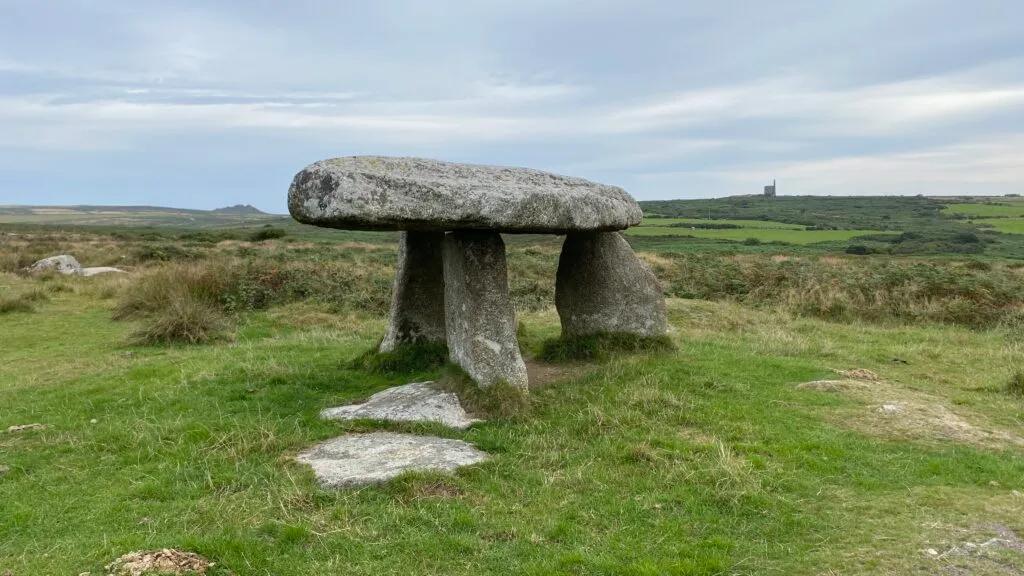
Not far from Chun Castle, Lanyon Quoit is one of Cornwall's most photographed ancient sites, and for good reason. Its enormous capstone rests on upright slabs like a giant stone table. Originally part of a much larger burial mound, it was re-erected in the 19th century after collapsing in a storm.
Walk required: very little. Visible from the road with parking nearby.
Why visit: iconic, accessible, and a good stop-off en route to more remote sites.
Local tip: best viewed in early morning light or golden hour when it feels particularly otherworldly.
3. Men-an-Tol
Men-an-Tol is a site that sparks the imagination: a circular holed stone flanked by two upright stones. Some say it's part of a lost stone circle, others a former burial chamber. For centuries it has been a site of folklore and healing, with legends claiming that passing through the holed stone could cure ailments or even increase fertility.
Walk required: around a 1.2-mile round trip on uneven paths. Park at the layby just past Boskednan Farm.
Why visit: small but striking, with a powerful sense of place. Kids love crawling through the holed stone (for luck, naturally).
Local tip: combine it with Boskednan Stone Circle for a proper loop.
4. Boskednan Stone Circle
Often called the Nine Maidens, though there are more than nine stones, Boskednan Stone Circle lies in a remote, heather-covered part of the moor. It's one of those places where the landscape seems to fall away around you. On a misty day, it's like stepping into another time.
Walk required: moderate. Usually paired with the Men-an-Tol walk (about 2 miles round trip total).
Why visit: remote, unspoiled and rarely busy. Great for walkers wanting a wilder experience.
Local tip: bring OS Explorer Map 102. This part of the moor isn't always well-signposted.
5. Carn Euny Ancient Village
This Iron-Age and Romano-British settlement is one of Cornwall's best-preserved ancient villages. It includes the remains of stone houses and a fogou, an underground passage whose purpose still puzzles historians (ritual? refuge? storage?).
Walk required: easy. Around 10 minutes' walk from the small car park.
Why visit: the site is peaceful and incredibly evocative. The fogou in particular is a highlight, torch recommended.
Local tip: visit late afternoon when the site is quiet and the low sun makes the stonework glow.
6. Chysauster Ancient Village
Unlike many of Cornwall's prehistoric sites, Chysauster has a staffed visitor centre and a small entrance fee (free to English Heritage members). It features eight stone-walled courtyard houses, arranged in pairs, and offers insight into how people here lived nearly 2,000 years ago.
Walk required: minimal. There's a surfaced path from the car park.
Why visit: well-interpreted and easy to picture daily life here. Less wild, more educational.
Local tip: combine it with a visit to nearby Ding Dong Mine or a moorland walk for a fuller day out.
7. Ballowall Barrow
Perched dramatically on the cliffs near St Just, Ballowall is a unique Bronze-Age burial cairn with concentric stone walls and burial chambers. It was partially excavated and reconstructed in the 19th century, but still gives a real sense of its original form.
Walk required: short walk from the car park at Cape Cornwall.
Why visit: the setting is phenomenal, with sweeping views over the Atlantic. A great sunset spot.
Local tip: bring a picnic and enjoy the coastal views. Then take a walk down to Priest's Cove below.
Frequently asked questions
What are the most famous ancient sites in Cornwall?
The Penwith peninsula in west Cornwall holds many of the best. Lanyon Quoit is the iconic photographable dolmen, Men-an-Tol the famous holed stone, Boskednan (Nine Maidens) a remote stone circle, Carn Euny and Chysauster Iron-Age villages, and Ballowall a Bronze-Age cliff-top burial cairn near St Just.
Where can I see standing stones in Cornwall?
The Penwith Moors near Pendeen and Madron have the highest concentration. Men-an-Tol is the best-known holed stone, Boskednan stone circle (Nine Maidens) is a short walk further on, and the moors around them are dotted with smaller standing stones. Most are accessible on foot from a layby or small car park.
What is Lanyon Quoit?
Lanyon Quoit is a Neolithic dolmen, a stone burial chamber built around 4,000 to 5,000 years ago. A massive flat granite capstone rests on three upright slabs, originally part of a much larger burial mound that has since eroded away. It collapsed in a storm in 1815 and was re-erected in 1824, though slightly lower than the original.
How do I get to Men-an-Tol?
Park at the layby just past Boskednan Farm on the road from Madron. Follow the signed track for about half a mile across moorland to reach the holed stone. The path is uneven and can be boggy in winter, so wear waterproof boots. The walk is about 1.2 miles round trip.
How old are Cornwall's stone circles and quoits?
Most date from the Neolithic and Bronze Age, between 3,000 and 5,000 years old. Quoits like Lanyon and Chun were built around 3,500 BC as burial chambers. Stone circles like Boskednan are slightly later, from around 2,000 to 1,500 BC. Iron-Age villages like Chysauster and Carn Euny were inhabited from around 500 BC into the Roman period.
Is Chysauster Ancient Village worth visiting?
Yes, especially if you want context. Chysauster is the most-interpreted of Cornwall's ancient sites, with a staffed visitor centre, paths, and clear signage explaining the eight courtyard houses. There's a small entrance fee (free for English Heritage members). Carn Euny is a wilder alternative with a fogou underground passage and no fee.
Can I visit Cornwall's ancient sites for free?
Most are free and unstaffed. Lanyon Quoit, Men-an-Tol, Boskednan, Chun Quoit, Carn Euny and Ballowall Barrow are all open access with no admission charge. Chysauster is the exception, with a small fee (free for English Heritage members).
How long does the Penwith ancient sites walk take?
Allow a full day if you want to see the main sites. Lanyon Quoit is roadside, Chun Castle and Chun Quoit are a 1-mile moorland walk, and the Men-an-Tol plus Boskednan loop is around 2 miles. Driving between the western and eastern clusters takes 20 to 30 minutes. Two unhurried days is more comfortable.
Walking the ancient west
There's something incredibly grounding about walking out into the moors and coming across a place where people gathered, worshipped, or were buried thousands of years ago. These aren't fenced-off museum pieces. They're open, exposed, and part of the land itself.
You don't need to be an archaeologist to feel the pull of these sites. Whether you're drawn to their history, their mystery, or just want an excuse to hike through some of Cornwall's most dramatic landscapes, this route is something special. Pair it with a stretch of the Pendeen-to-Sennen section of the South West Coast Path for a full day of mining heritage, ancient sites and Atlantic cliffs.
Pack walking boots, charge your phone for OS Maps, and give yourself the space to slow down and explore. Just mind the bogs.
Tags
Stay in touch
Occasional Cornwall updates from Rich at Trewena. Around four times a year, never more.
Planning a trip to Cornwall?
Three one-bedroom cottages on a smallholding on the edge of Falmouth. A genuine Cornish base for couples and singles.