Drive through Cornwall for the first time and the road signs can make you feel like you’re in a foreign country, which, in a linguistic sense, you are. Alongside the English, the Cornish names scroll past: Porthtowan, Tregony, Pendhu, Truro. Most visitors read them without a second thought, but once you start to understand what they mean, the landscape begins to speak.
Cornwall’s place names are among the oldest in Britain. The Cornish language – Brythonic Celtic tongue closely related to Welsh and Breton – was spoken here long before English arrived, and while the language itself largely faded from everyday use by the eighteenth century, it left its fingerprints all over the map. Cornish place-naming worked on a simple, functional logic: a compound of two elements, a feature and a description. The main difference from English is the order. Where English puts the qualifier first (as in “new-castle” or “ring-wood”), Cornish puts it second. So you get the thing, then its character.
Once you know a handful of prefixes and suffixes, the countryside unlocks itself.
Tre- is probably the most common element you’ll encounter, meaning “farm” or “settlement.” It appears hundreds of times across the county — Truro, Trelowarren, Tregothnan. Wherever you see tre-, you’re looking at a place that was once someone’s farmstead.
Pen- means “head” or “headland” or “end” — Penzance (holy headland), Penryn (headland), Pendhu (black headland).
Pol- gives us “pool” or “pit,”
bos- means “dwelling” or “cottage,” and
ros- refers to a promontory or heath. Adjectives embedded in names include -dhu (black), -vean (small), and -noweth (new) — so Poldhu is “black pool,” and Trenoweths are scattered liberally across the county.
Some of the most evocative names are actually corruptions; English tongues gradually wearing Cornish words into new shapes. For example a small headland at Newquay was once Lost an glaze, plain Cornish for “grey-green promontory.” It’s now known as Lusty Glaze, which sounds considerably more dramatic. Scawgack, meaning simply “place of elder trees,” became Skewjack. A cove near Land’s End began as Porth-east (“Just’s Cove”), eroded to por-east, then per-east, and now appears on maps as Priest’s Cove. The Manacles — one of the most dangerous reef systems on the British coast, notorious for shipwrecks — sounds suitably menacing in English, but is almost certainly a corruption of the Cornish maen eglos, meaning “rocks of the church” (St Keverne’s steeple is visible from the rocks). Something prosaic became something that sounds like an instrument of doom.
This is how language works in landscape. Names accumulate, shift, get passed down through generations of people who may not have spoken the original tongue, softening consonants and losing syllables until something new emerges; still rooted in place, still functional, but wearing a different coat.
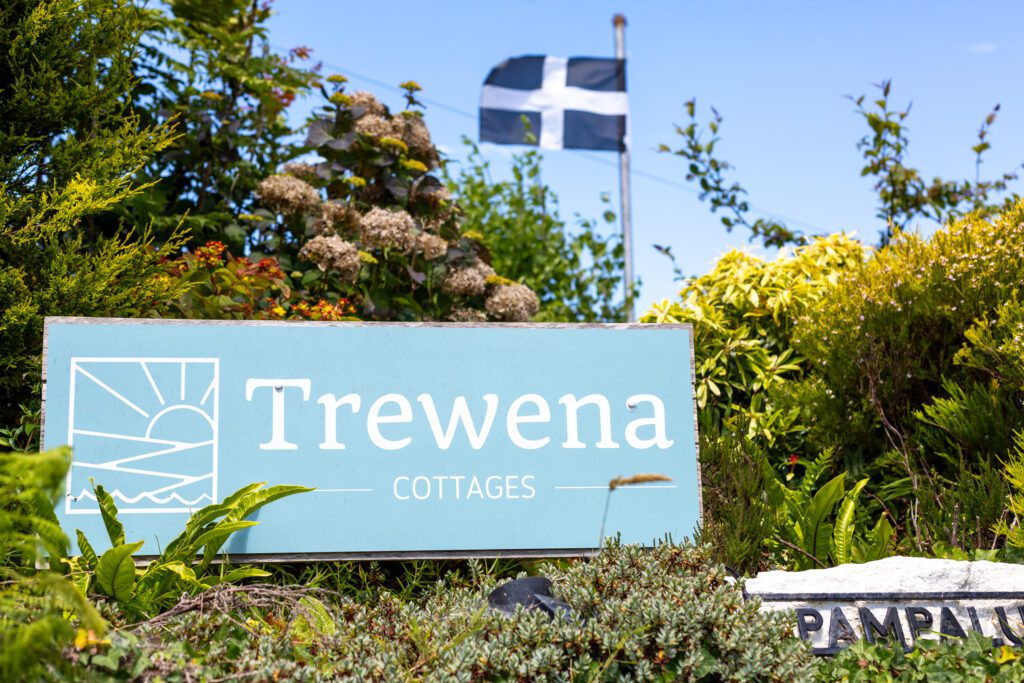
For those of us who live and work here, these names aren’t just etymology, they’re identity. Take our own smallholding; Trewena, a name that follows exactly the pattern described above. Tre-, farm or settlement, combined with -wena, a shortening of sowena, Cornish for prosperity. Prosperity Farm, quite simply. It felt like the most natural thing in the world to name a place by what you hope it will be.
Incidentally having lived and worked in China and Hong Kong, I’d absorbed something of a cultural habit: the idea that a name carries intention. In Chinese culture, businesses and homes are often named to invite good fortune – prosperity, longevity, harmony – not superstitiously exactly, but as a kind of orientation, a statement of what you’re working toward. With those sensibilities it turns out that this place was great for us in more ways than one! The language already has the vocabulary; the landscape already holds the meaning. Tresowena, prosperity — it was there waiting.
So Trewena sits in that long tradition of Cornish place-naming: functional, grounded, a compound of what the place is and what it aspires to be. When guests arrive, they probably don’t think about any of this. But the name is doing its quiet work regardless, as Cornish names have always done — holding something of the place and the people within it, long after the original speakers have gone.
If you’re driving through Cornwall and you want a simple game to play as the signs go past, start with tre- and pen-. You’ll spot them everywhere. Then look for pol-, ros-, bos-. Before long you’ll find yourself reading the landscape differently — not as a series of arbitrary labels, but as a palimpsest, layer upon layer of people naming the world around them in the most practical and human way possible: this is here, and this is what it’s like.
That, when you think about it, is what all good names do.